 Plain Words
A Piano Player, Eight Badges and One Sentence: The Front of a Brain Supplement
Two tablespoons a morning come out of this 32-ounce amber bottle from Mesquite, Nevada. Most write-ups start with the panel on the back, so I started with the side that faces you while you pour.

This is a paid advertisement. Sponsored by Liquid Health, Inc.

Every bottle has two faces, and almost nobody reads the one they see most.
The back carries the panel of numbers, and that is where reviews go to argue.
The front is the side that faces you every single morning, while you shake, pour and put the bottle away.
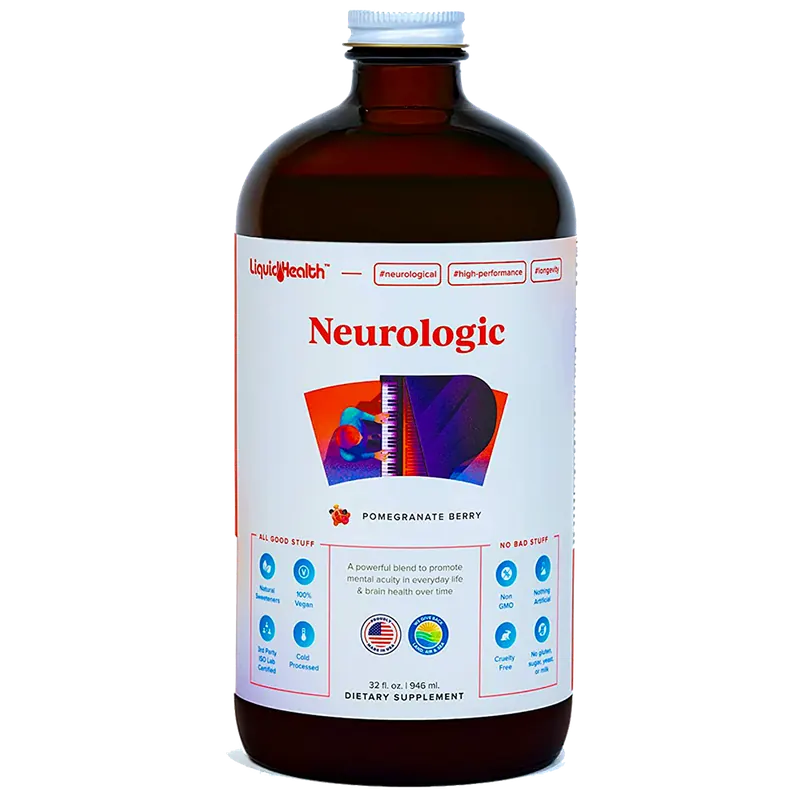
This one carries a drawing of a piano player, three tags, eight small badges, two round seals and one sentence of fifteen words.
I read every one of them in plain English, the way you would read a note left on the kitchen table.
Then, and only then, I turned the bottle around.
Arthur Delaney is the pen name of this desk.
Everything on this page about the bottle comes from the seller's own product page, its label photographs, its policies and its public review system, read in September 2026.
The man who brings the bottle in below is a composite of readers who write to this column, not one person.
The four customers quoted further down are real, and their words are public on the seller's page.
The small pictures beside them are illustrations, not the reviewers.
I have written the plain-English column at this desk for a long time.
The job is simple to describe and slow to do.
Somebody brings me a piece of small print, and I say back to them what it means in the words they would use at their own table.
No jargon, no verdict shouted from a height, and no word left out because it was inconvenient.
This month the small print was on a tall amber bottle.
It is called Neurologic, it holds 32 fluid ounces, and it is poured two tablespoons at a time.
The man who brought it to me had already read the back.
He had read the back twice, in fact, and he had the same complaint about it that everyone has.
He said the back was a list, and the front was the part that was talking to him.
That stopped me, because he was right, and because I had never read a label that way round.
The panel on the back is written for regulators and for people like me.
The front is written for you.
It is the side a company chooses to turn toward your kitchen, and every word on it was picked by somebody who wanted you to feel a certain way about the thing in your hand.
So this page reads the front first, badge by badge and word by word, and says what each one means and what it does not.
The back comes later, in its own sections, because the back still decides what is actually inside.
I will give you the shape of it now, so nobody has to hunt for where this lands.
Most of the badges on the front say something true and fairly modest.
The sentence under the name says something larger, and the back of the bottle can only partly carry it.
And one of the most useful facts about this product is not a badge at all: it is the seller's policy, which names the taste before it names anything else.
That is the whole page in four lines, and the rest is the reading.
Thirty Mornings Facing the Same Side of a Bottle
Think about how a bottle like this lives in a house.
It comes out of the refrigerator door once a day.
You shake it, because the label tells you to.
You unscrew a metal cap, tip the bottle over a spoon and pour.
Then the cap goes back on and the bottle goes back into the door.
The whole thing takes less time than it takes the coffee to drip.
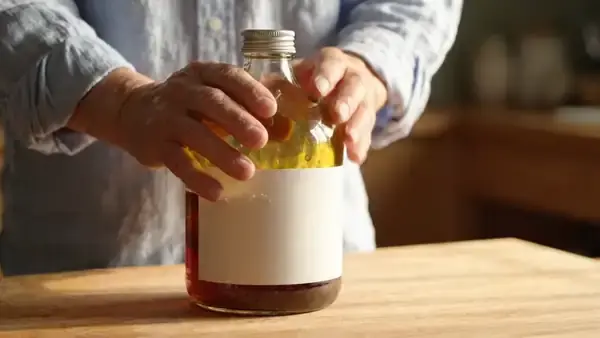
In those few seconds, the side of the bottle that faces you is the front.
It is the side your hands wrap around, the side your eyes land on while the spoon fills.
A 32-ounce bottle poured two tablespoons at a time lasts thirty-two mornings.
That is thirty-two times you look at the same drawing, the same badges and the same sentence.
Nobody turns a bottle around thirty-two times to reread a panel of milligrams.
But the front gets read thirty-two times whether you mean to read it or not.
That is why the front matters more than people give it credit for.
It is the part of a label that does its work by repetition, the way a sign on a road you drive every day does.
None of that is sinister.
Every product in your kitchen does the same thing, from the cereal box to the jar of peanut butter.
But a supplement is different from peanut butter in one respect.
The words on its front are making a claim about your body, and those words deserve the same slow reading you would give a contract.
So that is what I did, starting at the top of the label and working down, the way the eye travels.
A Figure at a Piano Keyboard
The first thing on the front that is not a word is a picture.
In the middle of the white label, under the name, sits a small illustration in orange, violet and blue.
It shows a figure seated at a piano keyboard, leaning into the keys, drawn in bold flat shapes.
It is a handsome little drawing.

A picture on a label is not a claim in the legal sense.
It does not promise anything, and nobody could hold a company to a drawing.
But a picture is a message, and it is worth saying in plain words what this one says.
A person at a piano is a person using the mind and the hands together, fluently, without stopping to think about where the next note is.
That is the feeling the label wants to hang on the bottle.
Fluency, practice, the sense of a skill that is still there when you reach for it.
A drawing like that can make a label feel like a promise without printing a single promise.
That is not a ploy peculiar to this company; it is how packaging has worked for as long as there has been packaging.
The plain reading is short.
The piano player is decoration, and a nice piece of it, and nothing on the back of the bottle connects any ingredient to playing an instrument, learning one or getting better at one.
If you play, keep playing.
Of everything in this story, the piano is the part with the most going for it, and it does not come in a bottle.
Fifteen Words Under the Name
Directly under the picture, in a small box of its own, sits the only full sentence on the front of the bottle.
Here it is, word for word.
"A powerful blend to promote mental acuity in everyday life & brain health over time"
Fifteen words, counting the ampersand.
Every one of them was chosen, so every one of them gets read.
"A powerful blend."
The word powerful has no measurement behind it on this label.
It is an adjective of enthusiasm, the same one you would find on a dish soap.
Nothing on the back tells you what the blend is powerful compared with, or by how much.
"To promote."
This is the most important word in the sentence, and the least noticed.
Supplement labels in the United States are allowed to describe how an ingredient relates to the normal structure or working of the body.
They are not allowed to say a product acts on a medical condition, and so the verbs on supplement labels come from a small, careful family: supports, promotes, helps maintain.
Promote is one of those verbs.
It points in a direction without saying how far you will travel, and it is chosen precisely because it does not commit to a distance.
That is also why every supplement label that uses a verb like this carries a line of small print with an asterisk.
You will find the same line at the foot of this page, saying that the statements have not been evaluated by the Food and Drug Administration.
"Mental acuity."
Acuity means sharpness, the way it does in "visual acuity" at the eye chart.
Mental acuity is a pleasant phrase, but it is not a thing anyone measures under that name.
Researchers test specific jobs of the mind: how fast you react, how many words you recall from a list, how many mistakes you make holding numbers in your head.
When you read the research further down this page, you will see those specific tests, not the word acuity.
The front of a bottle gets to use the big warm word; the back of the bottle has to live with the narrow tests.
"In everyday life."
This phrase sets the scene at your kitchen table, on the drive to the store, at the crossword.
It is the right setting, and a modest one.
It does not claim anything about a laboratory, a test or a result, only about the ordinary day in which you would like to feel sharp.
"And brain health over time."
This is the second half of the sentence, and it quietly changes the time scale.
The first half is about today.
The second half is about years.
A sentence that covers both today and the long run is covering two very different kinds of promise at once.
Something that helps you feel alert this afternoon and something that matters over a decade would need two very different kinds of evidence.
Neither kind is printed on the bottle.
The back of the bottle is where you would go to see whether the ingredients, at the amounts inside, have been shown to do either.
I will tell you now that for the long run, the best trials of two of the named ingredients came out even with placebo.
For the short run, a couple of the names have small studies of single doses behind them.
I will lay those out, one at a time, when we turn the bottle around.
Three Tags Across the Top of the Label
Above the name, in a row of small outlined boxes, the label prints three words with a hash sign in front of each.
They read #neurological, #high-performance and #longevity.
A hash sign in front of a word is how people file posts on social media so that others can find them.
On a bottle, it does no filing at all.
It is a style, borrowed from the phone in your pocket, meant to make a supplement feel current and a little bit shareable.
That is all a tag on a label is.
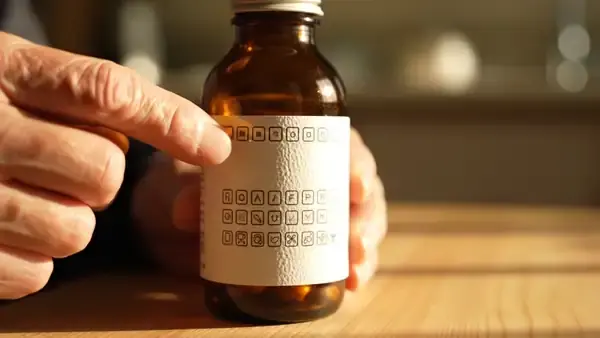
#neurological is a close cousin of the product's name, Neurologic.
It means having to do with the nerves and the brain, and on a label it signals the subject, not a result.
#high-performance is a phrase from cars and athletics.
It is aimed at the part of you that wants to be at your best, and there is nothing on the back of the bottle that measures performance of any kind.
#longevity means long life.
It is the most ambitious of the three words, and the one with the least behind it, because no ingredient on this panel has been tested on how long people live.
Put plainly, the three tags are a wish list.
They tell you the three feelings the company wants the bottle to carry: brain, best, long.
A tag is a label on a label. It names a hope, not a finding.
The Column Headed All Good Stuff
Below the sentence, the label splits into two narrow columns of small round icons, each with a few words underneath.
The column on the left is headed All Good Stuff.
It holds four badges.
Each one is worth reading, because each one makes a smaller and more checkable statement than the sentence above it.
The badge about sweeteners
The first badge says the sweeteners in the bottle come from plants.
It is a claim about the source, not about the amount.
The panel on the back supports part of it.
A serving has five calories, one gram of carbohydrate and zero grams of sugars, which means the sweetness is not coming from ordinary sugar.
What the panel does not do is name the sweetener.
Most supplement panels end with a line called other ingredients, listing the base liquid, the flavor and the sweetener, and this panel has no such line.
So the plain reading is: sweetened, low in calories, sugar not listed, sweetener not named.
If you care which plant-based sweetener it is, that is a fair question for the company's phone line, and I will give you the number and the hours near the end.
The vegan badge
The second badge says the product is vegan.
The panel is consistent with that, because every named ingredient comes from a plant, a mineral or a laboratory rather than an animal.
The choline is from choline bitartrate, a salt made for supplements.
The phosphatidylserine, which is often made from soy or sunflower, is listed as coming from non-GMO soy.
That soy detail matters later, for a different reason.
For now, the vegan badge reads true against the panel.
The laboratory badge
The third badge says "3rd Party ISO Lab Certified."
That is five words of small print that sound more exact than they are.
ISO is the International Organization for Standardization, the body that writes technical standards for almost everything, from screw threads to how a testing laboratory should run.
A third party is simply someone other than the seller.
So the badge is saying that a laboratory outside the company, one that meets an ISO standard, has done something with this product.
What it does not say is which laboratory, which standard, what was tested, or what the result was.
A test badge without the test is a pointer, not a report.
It is not nothing, but in plain words it is a promise that a report exists somewhere, and you would have to ask to see it.
If you are the kind of reader who likes to see paperwork, ask for a certificate of analysis for the batch in your hand.
Some companies send one without fuss, and the way a company answers that question tells you a good deal.
The cold-processed badge
The fourth badge in the left column says "Cold Processed."
It means the liquid was made without heating, or at least without heating above some level.
The label does not say what temperature, at which step, or for which ingredients.
There is no single definition of the phrase printed anywhere on the bottle.
The idea behind it is reasonable.
Some vitamins and plant compounds do not like heat, and a maker who keeps things cool is making a sensible choice.
But the badge describes a manufacturing choice, not a result in your body.
It tells you how the liquid was made, and nothing about what it does once it is in your glass.

The Column Headed No Bad Stuff
The right-hand column is headed No Bad Stuff, and it also has four badges.
Where the left column says what is in the bottle, this one says what is not.
Non GMO.
This means the ingredients are not from genetically modified crops.
It fits the panel, which specifies non-GMO soy for the phosphatidylserine.
Whether that matters to you is a personal choice more than a health one, and the badge makes no health claim, which is to its credit.
Nothing Artificial.
This badge says there are no artificial colors, flavors or sweeteners in the liquid.
Without an other-ingredients line on the panel, it is hard to check from the bottle alone.
It is a statement you take on the company's word, and a reasonable question to ask them in writing if it matters to you.
The badge about animal testing.
The third badge says the product was not tested on animals.
That is an ethical statement about how the company works, and nothing in it touches your health one way or the other.
It sits comfortably beside the vegan badge.
No gluten, sugar, yeast or milk.
The last badge lists four things the liquid leaves out.
This is the most useful badge on the whole front for anyone with a reason to avoid one of those four.
Against the panel, the zero grams of sugars line agrees with it.
There is one thing the right-hand column does not list, and the store pages around the bottle get it wrong.
On the seller's product page, a row of little tags beside the photograph says the product contains no soy.
The panel on the bottle says the phosphatidylserine is from non-GMO soy.
Both cannot be right.
A small amount of soy-derived phosphatidylserine may not trouble most people, but anyone who avoids soy for a real reason should go by the bottle, not the tag beside the photograph.
When a store tag and a printed panel disagree, the panel is the one the law reads.
It is also the one in your hand.
Two Round Seals and Two Words at the Bottom
Between the two columns, near the bottom of the label, sit two round seals.
The one on the left carries a small American flag and the words Proudly Made in USA.
Made in USA is a phrase with rules behind it when a company uses it plainly, and the plainest reading is that the product was made here.
The label does not say where each of the fifteen ingredients was grown or produced, and it is common for a domestic maker to buy raw materials from abroad.
The seal on the right is a small round mark in blue, green and yellow.
In the seller's own photograph of the bottle its lettering is too small to read, and I will not guess at what it says.
If a seal is too small to read, it is not doing much reading for you either.
At the very bottom, below the seals, the label prints its size and its category.
The size reads 32 fl. oz. and 946 ml, which is the same amount in two systems.
The category reads Dietary Supplement, and those two words matter more than any badge above them.
They tell you the regulator's shelf this product sits on.
A dietary supplement in the United States is regulated more like a food than like a medicine.
The company is responsible for what it puts in the bottle and for the truth of what it prints, but the words on its front are not checked and approved by the government before the bottle goes on sale.
That is exactly why the asterisk line exists, and why you will find it, word for word, at the foot of this page.
It is not a scare line; it is simply the rule of the shelf the product lives on.

One Flavor, Printed Two Ways
Between the picture and the badges, next to a small drawing of fruit, the label prints the flavor: Pomegranate Berry.
On the seller's product page, the same liquid is called Berry Pomegranate.
It is a tiny thing, and I would not mention it if this page were not about reading words carefully.
The same flavor, printed in two orders, tells you the label and the web page were written at different times or by different hands.
It changes nothing about the liquid.
But it is a good reminder that the words around a product are made by people, in batches, and they do not always agree with one another.
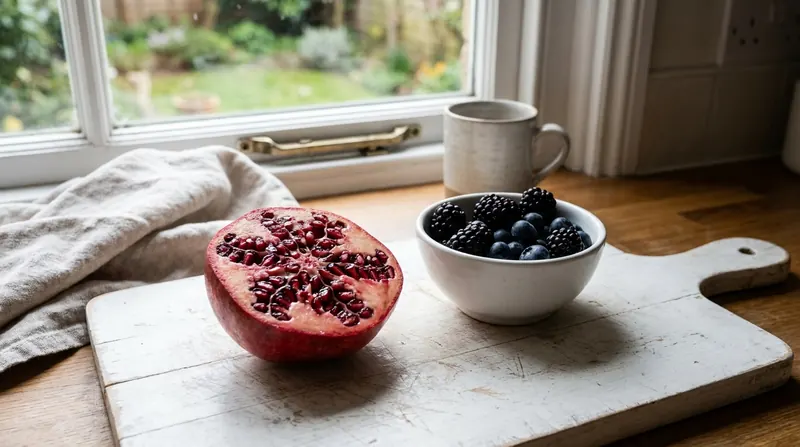
What matters more than the name of the flavor is the flavor itself.
With a liquid supplement, taste is not a side issue.
You do not swallow this with water in one gulp and forget about it.
You taste it every morning, two tablespoons of it, for as long as you keep taking it.
That makes taste the thing most likely to decide whether a bottle like this gets finished or gets forgotten in the back of the refrigerator.
The buyers who reviewed it on the seller's page knew that, because taste is the subject they return to most.
One reviewer, who gave it four stars, wrote that she was having a bit of trouble getting used to the taste.
Another, who gave it three, wrote that the taste was very tolerable.
Those two sentences are the most honest description of the flavor I could find, and they point in different directions.
That is what flavor does; it divides a room.
The seller's own questions page says the liquid can be mixed into a drink.
If the taste is the obstacle, that is the plain answer, and it costs you nothing but a glass.

A policy that names the taste first
Here is the fact about this product that surprised me most, and it is not on the label at all.
It is in the seller's return policy.
The company says that if you do not like the product for any reason at all, and it lists taste first, then packaging, then effect, you can call or write within thirty days of buying it.
Taste, packaging or effect, in that order.
I have read a great many supplement policies, and very few of them name the taste at all, let alone put it first.
It tells you the company knows exactly where a liquid is most likely to fail you, and it is honest enough to say so.
There is a catch, and it belongs right beside the good news.
The company does not give your money back; it exchanges the bottle for another product or gives you store credit.
And it only covers bottles bought directly from its own website.
I will come back to both of those points when we get to buying it.
Two Tablespoons, Measured the Plain Way
The directions on the bottle are three short instructions.
Shake well, take two tablespoons daily for best absorption, and refrigerate after opening.
Each of them is worth a sentence of plain explanation, because each of them is a small daily job.
Nothing else on the label asks anything of you.

Shake well.
A liquid with fifteen ingredients will not stay perfectly even while it stands in the door of a refrigerator.
Some parts settle, and a shake puts them back where they belong.
If you skip the shake, the first spoonfuls and the last spoonfuls of the bottle may not be quite the same liquid.
Two tablespoons.
A tablespoon is a measure from the kitchen, not from the pharmacy.
In a recipe it means fifteen milliliters, and two of them make one fluid ounce, which is what the panel calls a serving.
The trouble is that the spoons in a cutlery drawer come in all sorts of sizes, and a soup spoon from your drawer is not a measuring tablespoon.

The plain answer is a proper measuring spoon, the kind that comes in a ring of four.
The store includes a small measuring cup with larger orders, which is another sensible way to pour a fluid ounce.
Why fuss about this?
Because the only numbers on the whole bottle are per serving, and a serving only means something if the spoon is the size the label assumed.
Refrigerate after opening.
Once the seal is broken, the bottle lives in the cold, like a carton of juice.
That is a practical point more than a health point.
It means the bottle needs a spot in the refrigerator door, and it means it cannot live in a desk drawer or a travel bag.

Put the three instructions together and you have a routine of perhaps half a minute.
Shake, measure, pour, cap, back in the door.
The one part of the directions I would read twice is the phrase "for best absorption."
It sits in the instructions as if it were a plain fact, and I could not find the evidence that would make it one.
I will come to that claim in its own short section, because the seller makes a larger version of it on the web page.
For now, the plain reading is that two tablespoons is simply the serving, and the words about absorption are the seller's own.
A serving is whatever the label says it is. A benefit is whatever the evidence can carry.
Turning the Bottle Around
That is the front, all of it, from the tags at the top to the two words at the bottom.
Most of it is modest and checkable, and one sentence of it is large.
Before it turns, it is worth seeing the whole thing at once, standing on the counter the way it stood every morning while I read it.
The company behind it is Liquid Health, Inc., with a street address on Cimarron Court in Mesquite.
Mesquite is a small desert town in the far corner of Nevada, a short drive from the Arizona line.
The bottle is glass, and it is the brown-orange color pharmacists and brewers have used for a century, because amber glass cuts down the light that reaches what is inside.
It is a practical choice, and it is also a look, and on this bottle it is both.
The cap is a plain metal screw cap.
There is nothing to snap off, no measuring cup built into the lid and no spout.
You bring the spoon. The bottle brings the rest.
To see how much of that sentence the liquid can carry, you have to turn the bottle around.
The back is where the numbers live.
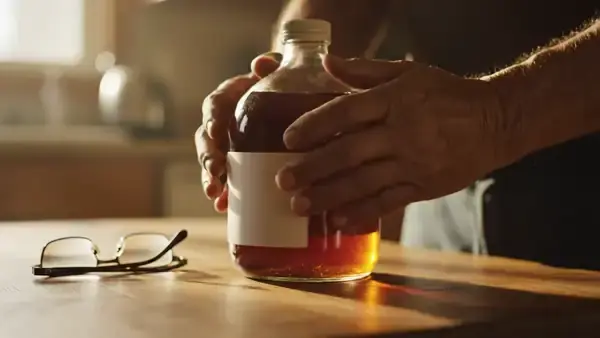
The panel on the back of Neurologic has two kinds of lines.
Four lines give a vitamin or nutrient with an amount and a percentage of the day.
Then come two lines called blends, each with a total weight and a list of names underneath, and no amount beside any of the names.
The four measured lines come first, so they come first here.
Vitamin B12: 400 micrograms
The biggest number on the panel belongs to vitamin B12, in a form called methylcobalamin.
A serving gives 400 micrograms, and the panel prints that as 16,667 percent of the Daily Value.
That percentage is correct arithmetic.
The Daily Value the Food and Drug Administration uses for B12 on labels is 2.4 micrograms, and 400 divided by 2.4 is about 167 times that amount.[1]
So the plain reading is: a very large amount of B12, printed honestly.
The next question is whether a very large amount does anything for a person who already has enough.
The best answer comes from a review of fourteen trials in nearly 28,000 adults whose thinking was healthy when they started.
It concluded that B-vitamin supplements, including B12, probably have little or no effect on overall thinking over periods of up to five years.[2]
That review does not speak for people who are actually short of B12.
And some older adults are: the National Institutes of Health notes that, depending on how it is defined, between 3 and 43 percent of older adults living at home are low in it, often because the stomach frees less of it from food with age.[3]
The same source says B12 has no upper limit, because the body does not store what it cannot use.[3]
In plain words, a big dose of B12 is unlikely to harm you, and unlikely to help unless you were low to begin with.
The only way to know which group you are in is a simple blood test at your next checkup.
That test, not a label, is the useful next step.
Choline: 100 milligrams
The second line is choline, 100 milligrams from choline bitartrate, printed as 18 percent of the Daily Value.
That percentage also checks out against the labeling tables.
Choline is a nutrient the body uses to make one of its main messenger chemicals and to build the walls of its cells.
Eggs, meat, fish and beans are the usual sources.
In a large community study of adults aged 36 to 83, people who ate more choline in their food did better on memory tests.[4]
That is an association with the whole diet, not a trial of a supplement, and it does not show that adding 100 milligrams from a bottle changes anything.
Vitamin E: 7.5 milligrams
The third measured line is vitamin E, 7.5 milligrams, printed as 50 percent of the Daily Value.
The arithmetic is right again.
The largest trial on vitamin E and thinking gave 6,377 women aged 65 and over a far larger dose every other day for up to nearly ten years.
It found no benefit to thinking compared with placebo.[5]
So the plain reading is a sensible half-day of an ordinary vitamin, with no special role in the story the front of the bottle tells.
Folate: the line that does not add up
The fourth line is folate, from calcium folinate, and here the panel prints two figures that cannot both be right.
It says 7.5 milligrams, and beside it, 50 percent of the Daily Value.
The Daily Value for folate on a US label is 400 micrograms.
Half of that would be 200 micrograms, and 7.5 milligrams would be many times the whole Daily Value, not half of it.
One of those two figures is a misprint.
It is almost certainly the kind of slip that happens when a label is set by hand, and I would not read anything darker into it.
But it is worth a phone call, because folate is a vitamin where the amount matters.
Large amounts of supplemental folate can blur a blood test for a B12 shortage, and anyone taking anything daily should know the real figure before adding this bottle.
The three other measured lines add up.
One does not, and a plain reader says so without making more of it than it is.
Eleven Names Sharing Two Numbers
Below the four measured lines come the two blends.
The first is called the Memory and Focus Blend, 815 milligrams, and the second is the alertness blend, 655 milligrams.
Between them they list eleven names.
Aloe vera juice, acetyl-L-carnitine, alpha GPC, phosphatidylserine from soy, L-theanine and alpha lipoic acid sit in the first.
L-tyrosine, DMAE, rhodiola root extract, ginkgo leaf extract and huperzine A sit in the second.
No name in either blend has its own amount.
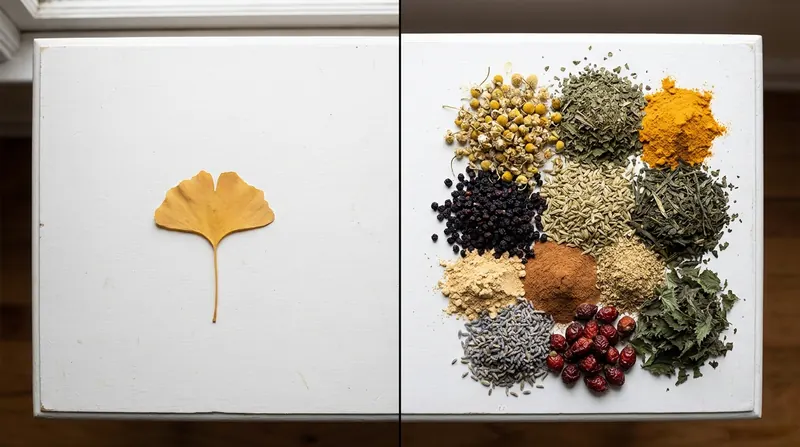
A blend with a total and no breakdown is legal on a US supplement label.
Companies say it protects their recipe, and that may be so, but it leaves the reader with one plain limit.
You cannot compare an ingredient with no amount to a study that used a measured amount.
The best you can do is say what the study used, and note that the bottle may hold more, less, or a little.
Whole articles could be written about these eleven names.
I will do it more briefly, in the plain way, starting with the name that has the biggest trial behind it.
Phosphatidylserine is a fatty building block of cell walls, found in high amounts in the brain.
In a six-month trial of 78 Japanese adults aged 50 to 69 with memory complaints, test scores rose about equally in the soy phosphatidylserine groups and the placebo group.[8]
Only the people who started with lower scores improved more than their own starting point.
The main comparison with placebo, in plain words, came out even.
L-theanine is an amino acid found in tea.
In a study of Japanese adults aged 50 to 69, a single dose was associated with a faster reaction time on an attention task and fewer errors on a working-memory task.[9]
That was one dose, measured the same day, and the study summary does not give the amount.
It is a small, real finding about a single afternoon, not about years.
Rhodiola is a root from cold, high country.
In a study of 56 young hospital residents on night duty, one tablet a day of a standardized extract was linked with better scores on tests of mental tiredness over the first two weeks.[10]
Young residents on night shifts are not men in their sixties at a kitchen table.
It is a narrow finding, and it is honest to say so.
L-tyrosine is an amino acid from protein foods.
A 2015 review concluded it seems to help mainly in short, demanding situations, and that its usefulness outside those moments looks limited.[11]
Huperzine A is the one name in the second blend that works differently from the others.
It is a purified compound from a club moss that slows the enzyme breaking down one of the brain's messenger chemicals.
In a small study of healthy adults, single doses of 100 or 200 micrograms did slow that enzyme, but neither dose improved overall performance.[12]
Because it acts on the body more directly than a food does, it is the name on this label most worth mentioning to a pharmacist, and I will say more about that below.
The other five names, aloe vera juice, acetyl-L-carnitine, alpha GPC, alpha lipoic acid and DMAE, have no good trials in healthy adults on memory or attention that I could find.
The aloe most likely serves as part of the liquid base.
Eleven names, two numbers, and the best trial of the lot came out even.
That is not a reason to call the bottle worthless.
It is a reason to read the sentence on the front with the back in mind.
Where the Front Meets the Back
Now set the two faces of the bottle side by side and read them together.
This is the part of a plain reading that most people skip, and it is the part that matters.
The badges hold up well.
Vegan, non-GMO soy, zero sugars, a sweetener that is not sugar: the back agrees with the front on nearly every point, and the one disagreement is a store tag, not the bottle.
The size and the category hold up.
Thirty-two fluid ounces, two tablespoons a serving, thirty-two servings, a dietary supplement: all plain and all true.
The sentence holds up only in part.
"Everyday life" has a couple of small single-dose studies behind two of the names, at amounts the bottle does not print.
"Brain health over time" has the two largest long trials behind two of the names, and both came out even with placebo.
The B12 line is the one exception worth taking seriously, and only for someone who is actually low.
In plain words: the front is honest about what is in the bottle, and more hopeful than the back about what it does.
That is true of a great many labels, and it is worth knowing before you buy any of them.
The badges describe the liquid. The sentence describes a wish.
The Graphic About Liquids
There is one more claim to read, and it lives on the seller's web page rather than the bottle.
A graphic there, titled with the question of why a liquid, says the product's absorbability is vastly better than the solid forms you swallow with water.
The directions on the bottle make a milder version of the same point with the words "for best absorption."
It is the claim a liquid supplement most wants to make, because it is the one thing a liquid has that a capsule does not.
I looked for a study comparing this liquid with the same ingredients in solid form.
The seller does not publish one, and I could not find one.
That does not make the claim false.
Some nutrients may well be taken up a little differently from a liquid, and B12 in a supplement is already in the easy form the body does not need to release from food.[3]
But "vastly better" is a measurement word used without a measurement.
In plain words, it is the seller's belief, not a finding, and the page should say so.
What a liquid does change, clearly and without any study, is the habit.
You taste it, you measure it, you keep it cold, and you see it every time you open the refrigerator.
For some people that makes a daily routine easier to keep.
For others, the taste and the spoon make it harder, and both kinds of people are among the reviewers.

What a Glass of Water Has Behind It
Since this page is about reading plainly, it would be wrong to stop at the bottle.
Some of the cheapest things in your kitchen have better evidence behind them than anything on this label.
The first is a glass of water.
In a large Berlin study of 1,111 adults aged 60 to 89, those who were measurably dehydrated did worse over time on a test of how quickly they processed information.[13]
A review of 18 studies in more than 33,000 older adults found some evidence, though sparse, linking dehydration with poorer performance on tests of thinking.[14]
These are associations, not trials, but they point at something simple you can do before breakfast.
Two tablespoons of this liquid is one fluid ounce.
If you mix it into a full glass of water, the glass may be doing more of the plain good than the spoonful.

The second is the plate.
In a three-year trial of 604 older adults, a group following the MIND eating pattern and a group given a simpler diet with a little less food both improved on tests of thinking, by about the same amount.[15]
The plain reading of that trial is encouraging in an unexpected way.
It did not matter much which careful plan people followed; paying attention to food, with some support, went along with better scores in both groups.
The third is the piano on the front of the label, or whatever your version of it is.
A skill you practice, a walk you take at the same hour, a conversation you keep going: none of it comes with a percentage, and all of it is yours.

None of this is instead of the bottle, if you decide you want the bottle.
It is simply the part of the story that the front of a supplement never has room to print.
Four Buyers, Four Plain Sentences
The seller's page carries eighteen reviews in its review system.
Thirteen give five stars, four give four, and one gives three, for an average of 4.67.
Fourteen of the eighteen carry the review system's own buyer mark.
One five-star review says only that the person never got the product, which tells you something about star ratings in general.
I chose four that carry the buyer mark and that say something specific.
Two of them are about taste, one is about a result the writer could not see, and one is from a buyer who keeps coming back.

NeuroLogic is one of my go-to brain health supports. I will always have it in my health cupboard. I've tried many supplements - most I wouldn't buy again. This one I've bought several times, 3 or 4 bottles each time.

This is a great combination. Unfortunately, I am having a bit of trouble getting used to the taste. I do appreciate that they have tried to give this a good flavor; I am just not into it.

Taste is very tolerable. We have almost finished the bottle. Have not seen a difference that we can tell.

The product I purchased seems to be effective and works. So far so good. But need more time to feel how effective it actually is.
Read those four together and you get a fair picture.
One buyer is loyal, one struggles with the taste, one could not tell a difference, and one thinks it is working but wants more time.
That spread is what you should expect from any supplement, and a page that shows you only the loyal buyer is not showing you the room.
Reviews are opinions, not evidence, and the three-star one is as useful as the five.
Who Ought to Ask a Pharmacist First
Most of what is in this bottle is ordinary.
A few names are not, and a plain reading has to say which ones and why.
If you take anything daily, bring the bottle to your pharmacist before the first spoonful.
That is the single most useful sentence on this page, and it costs nothing.
Huperzine A is the first reason.
It acts on the same messenger system as some things people take every day, so it can add to their effect, and it can cause nausea, sweating or a slow heartbeat in some people.
Ginkgo is the second.
It may raise the chance of bleeding for anyone who takes something that thins the blood, and it is worth stopping before an operation.[7]
Alpha lipoic acid can change how cells take up glucose, which matters to anyone who keeps an eye on their glucose.
Phosphatidylserine here comes from soy, which matters to anyone who avoids soy, whatever the store tag says.
L-tyrosine is a raw material the body uses to make one of its own messengers, so anyone who takes something daily for the gland that sets the body's metabolic rate should ask first.
And the folate line, as printed, is a question worth settling before you start.
If you are pregnant or nursing, this is not a bottle for now.
DMAE and huperzine A in particular have no place there.
None of this is meant to frighten anyone away.
It is simply the part of the back of the bottle that the front has no room to mention.
Things This Bottle Does Not Do
Plain reading works best with a plain list.
Here is what the evidence above does not support, however the front is worded.
- It does not replace a blood test for B12 if you are worried about being low.
- It does not match the doses of the trials, because eleven of its fifteen ingredients have no printed amount.
- It does not have a published study of its own, of the liquid as sold.
- It does not have a published comparison showing a liquid is taken up better than a capsule.
- It does not stand in for a glass of water, a careful plate or a morning walk.
- It does not come with a cash refund, only an exchange or store credit.
And a short list of what it does do, in the same plain voice.
- It gives a large, honestly printed amount of B12, useful mainly to someone who is low.
- It gives a modest amount of choline and vitamin E, in line with its labels.
- It comes with a clear set of badges, nearly all of which the panel supports.
- It is sweetened without sugar, at five calories a serving.
- It comes from a company with a real address, a real phone number and a policy that takes taste seriously.
Buying It From Mesquite
Neurologic is sold directly by Liquid Health, Inc., from its own website.
The company's questions page says it is also sold on Amazon, at Walmart and in some health food stores.
Here is the plain point about that: the thirty-day exchange only covers bottles bought directly from the company.
If taste is your worry, and for a liquid it should be, that one fact is a good reason to buy the first bottle from the source.
The company ships within the United States only.
Standard shipping is $9.95 and is waived on orders over $75, with a day to prepare the order and three to five business days in transit; a faster option costs more.
The price is set by the store and changes with its offers, so this page does not print one.
You will see the current price, and the size options, on the seller's own page.
The calendar behind the thirty days
One more piece of plain arithmetic belongs here, because it changes how you use the first bottle.
The exchange window is thirty days, and it starts on the day you buy, not the day the bottle arrives.
The seller takes about a day to prepare an order and then three to five business days to deliver it.
Count the weekend, and the bottle usually reaches your door about a week after you paid.
That leaves roughly three weeks of mornings inside the window.
A full bottle holds thirty-two mornings, so the window closes with about a third of the bottle still in the door.
In plain words: you will not finish the first bottle before you have to decide about it.
That is not a complaint about the policy, which is more generous about taste than most; it is simply how the dates fall.
So the sensible way to use the first bottle is to decide early about the part you can judge early.
Taste you will know in a morning or two, and packaging on the first day.
Whether it does anything for you is the slow question, and three weeks is a short time to answer it.
If the taste is the problem, say so inside the window; that is exactly what the policy was written for.
Write the date you paid on a strip of tape on the bottle.
It is the plainest reminder there is, and it faces you every morning with everything else on the front.
If you want to ask the questions this page raised, the company lists a phone number, 1-800-995-6607, and an email, hi@liquidhealth.us.
Its customer service hours are weekdays from eleven in the morning to seven in the evening, Eastern time.
Three questions are worth putting to them.
Which sweetener is in the liquid, what is the correct folate figure, and may you see the laboratory report behind the ISO badge.
A company that answers those three plainly is a company worth buying from.
Thirty-two ounces, poured two tablespoons at a time
A liquid blend of vitamins, choline and eleven botanical and amino-acid ingredients, poured out two tablespoons at a time from an amber glass bottle.
SEE THE 32-OUNCE BOTTLESold and shipped by Liquid Health, Inc., Mesquite, Nevada · United States only · 30 days to exchange it or take store credit, taste included, on bottles bought direct
Plain questions, short answers
What does it taste like?
The bottle calls it Pomegranate Berry and the seller's page calls it Berry Pomegranate.
Buyers are split: one found it very tolerable, another had trouble getting used to it.
Can I mix it into something?
Yes, the seller says it can go into a drink. A glass of water is the plainest choice.
How long does one bottle last?
Thirty-two mornings at two tablespoons a day.
Does it need to go in the refrigerator?
Yes, once it is opened.
What if I do not like it?
Call or write within thirty days of a direct purchase. The company exchanges it or gives store credit, not cash.
Is it a medicine?
No. It is a dietary supplement, and its label statements are not evaluated by the Food and Drug Administration.
Should I ask anyone first?
Your pharmacist, if you take anything daily. Huperzine A and ginkgo are the two names to point out.
The Whole Label in Plain Words
If you read nothing else, read this.
It is the front and the back of the bottle in a dozen lines.
- The piano player is decoration, and nothing on the back connects to it.
- The sentence under the name uses "promote," the careful verb of the supplement shelf.
- "Everyday life" has small single-dose studies behind two names, at amounts the bottle does not print.
- "Brain health over time" has two long trials behind two names, and both came out even with placebo.
- The three hashtags name hopes, not findings.
- The eight badges are modest, and the panel supports nearly all of them.
- The store's soy tag disagrees with the panel; the panel says soy.
- The flavor is printed two ways, and taste is the first thing the seller's policy names.
- B12 is printed honestly at 16,667 percent, and it matters most to someone who is low.
- The folate line prints two figures that cannot both be right.
- The absorption claim is the seller's, with no comparison published.
- The exchange covers thirty days on direct purchases, as store credit or another product.
What I Told the Man Who Brought It In
He asked me the question everybody asks at the end.
Is it worth buying?
I told him what I have told you.
The front of the bottle is mostly honest, and the part that is not quite honest is the part that sounds the best.
If he wants a large dose of B12 in a form he can taste and measure, and he likes the idea of a morning routine he can see in the refrigerator door, this bottle does that plainly.
If he wants the sentence on the front to come true, the evidence on the back does not carry it that far.
He is the only one who can decide which of those two readings he is buying.
My job was to make sure he read both.
He took the bottle home.
He said he would call the number about the folate line first, and then decide.
That is exactly what a plain reader would do, and it is what I would do.
If you decide to try it, buy the first bottle direct, so the taste is covered.
Shake it, measure it with a real spoon, keep it cold, and give it the thirty days the policy gives you.
And whatever you decide about the bottle, drink the glass of water, eat the careful breakfast and play the piano, or whatever your piano is.
Those were never on the label, and they were always the best part of the morning.
The amber bottle with the piano on the front
A liquid blend of vitamins, choline and eleven botanical and amino-acid ingredients, poured out two tablespoons at a time from an amber glass bottle.
SEE THE 32-OUNCE BOTTLELiquid Health, Inc., 783 Cimarron Ct, Mesquite, NV · 1-800-995-6607, weekdays 11 to 7 Eastern · ships within the United States · 30 days to exchange it or take store credit on bottles bought direct
The seller's own page, with the current price, the label photographs and the full list of ingredients
Every line on the back of this bottle, both blends included, is written out in plain English in the ingredient guide linked at the foot of this page.
The guide also carries each ingredient's cautions, the references in full and the disclosures this page is required to make.